
Solar Rooftop Safety in 2026: The BOS Components That Quietly Prevent Failures

Written by
parikshit
When a rooftop system fails — a trip, an arc, a structure coming loose — the cause is almost never the panel. It’s usually one of the unglamorous BOS components that was undersized, uncertified, or installed in a hurry. As India’s rooftops multiply, getting these right is what separates a safe system from a hazard.
Drop-cap opening paragraph: Industry safety guidance is consistent on this: most rooftop incidents come from basic things being ignored — loose connectors, improper earthing, damaged cables, poorly routed wiring, or an unstable mounting structure. Every one of those is a BOS component or a BOS workmanship issue. Certified, correctly specced material doesn’t guarantee a safe install on its own, but it removes most of the ways a system can go wrong.
Earthing — The Component Nobody Notices Until It Fails
Earthing carries fault current safely to ground. Get it wrong and a fault that should trip harmlessly becomes a shock or fire risk instead. The practical essentials:
- Proper earthing cable sized to the system — commonly 16 sqmm aluminium for equipment/structure earthing, stepping up to 50 sqmm for main system earthing and lightning-arrestor runs
- Solid bonding of module frames and the mounting structure
- A clean, low-resistance path to the earth pit
It’s cheap material doing a critical job.
Surge & Lightning Protection
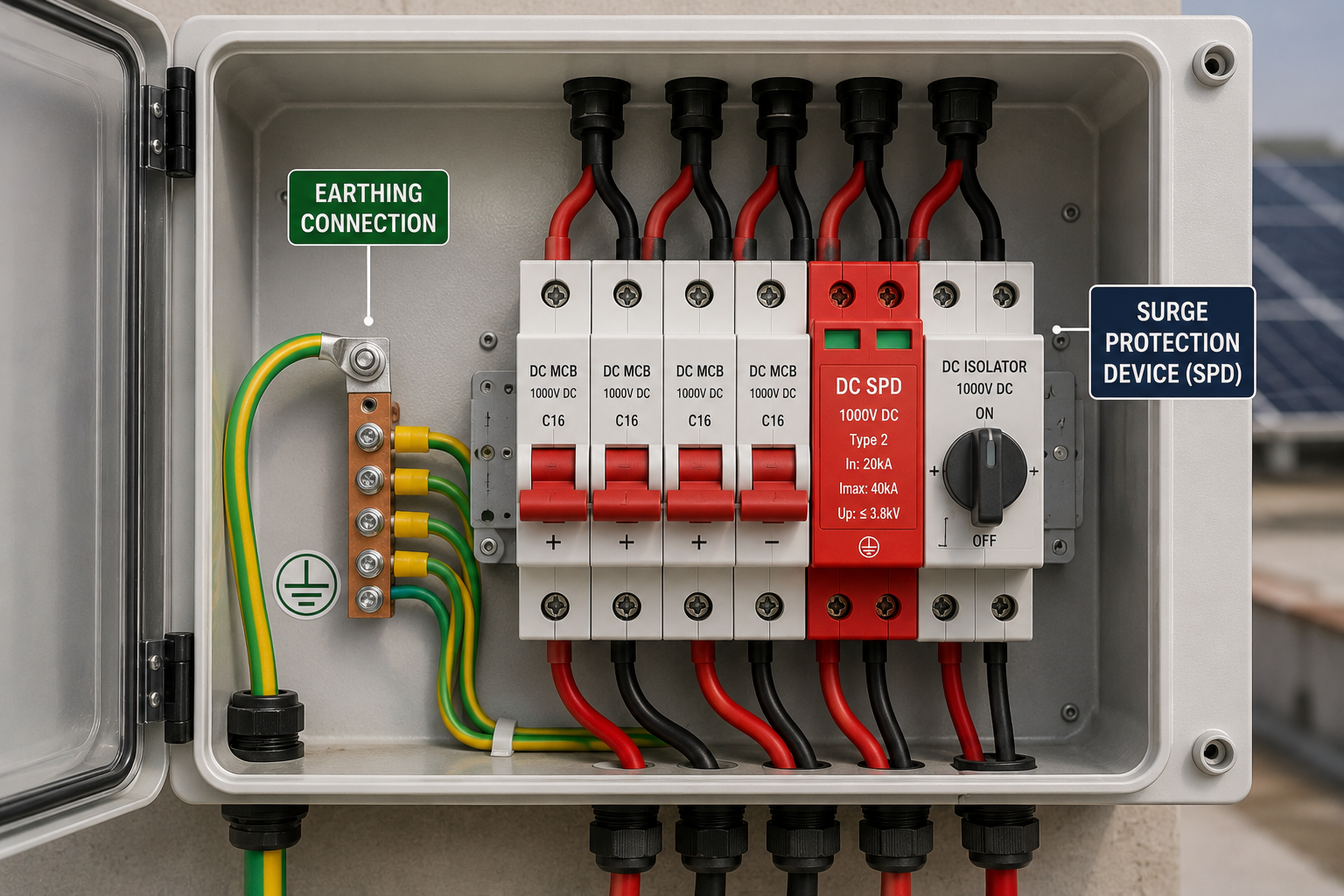
[Image: SPD installed in a DCDB. Alt text: Surge protection device in solar DCDB – lightning protection]
Rooftops are exposed, and India sees plenty of lightning. Surge Protection Devices (SPDs) in the DCDB and ACDB divert surge energy to earth before it reaches the inverter or the load. As a rule of thumb, Type 2 SPDs suit most rooftop and small ground-mount sites, with Type 1 where lightning exposure is higher. Skipping them to save a few hundred rupees is a false economy when a single surge can take out an inverter.
Safety isn’t one big component. It’s a dozen small ones doing their job — earthing, SPDs, fuses, fasteners — none of which you notice until one isn’t there.
DC-Side Protection
The DC side is the unforgiving one, because DC arcs don’t self-extinguish like AC arcs. That’s why the DCDB must use DC-rated fuses/MCBs, a DC SPD, and a DC isolator — never AC-rated substitutes. Combined with good connectors and clean terminations, this is what keeps a fault on one string from cascading into a bigger problem.
Structural Safety
A system has to physically stay put for 25 years. That means:
- A mounting structure matched to the roof and corrosion-resistant
- Quality fasteners — SS 304 J-bolts, properly torqued clamps and bolts
- Correct fixing for the roof type, not a one-size-fits-all approach
Loose or corroding hardware is one of the most common — and most preventable — long-term failures.
A Rooftop Safety Checklist (BOS Edition)
- Earthing cable correctly sized and properly bonded
- SPDs fitted on both DC and AC sides
- DCDB built with DC-rated components only
- Cables sized for current and run length, routed and secured cleanly
- Connectors fully seated (loose connectors are a top failure cause)
- Mounting structure corrosion-resistant and correctly fixed
- SS 304 fasteners, properly torqued
FAQ
What’s the most common cause of rooftop solar failures? Basic BOS issues — loose connectors, poor earthing, damaged or undersized cable, unstable mounting — far more often than panel faults.
Do I really need both DC and AC surge protection? For exposed rooftops in a lightning-prone climate, yes. SPDs are inexpensive compared with the inverter they protect.
Why DC-rated parts specifically in a DCDB? Because DC arcs don’t self-extinguish; AC-rated parts can fail to safely interrupt a DC fault.
Conclusion + CTA
Rooftop safety isn’t one heroic component — it’s a set of small BOS parts, each specced and installed properly. Get the earthing, the surge protection, the DC-side parts, and the mounting right, and most failure modes simply never happen.
Building systems that need to last?
We supply the safety-critical BOS — earthing cable, ACDB/DCDB with proper protection, SS 304 fasteners, quality structures — in bulk, pan-India.
[Get a bulk quote on WhatsApp →] (+91 93277 22400)

Written by
parikshit
Written by
