
BIS, ALMM and IS Standards: A Plain-English Compliance Guide for Installers (2026)

Written by
parikshit
Solar compliance in India has a lot of acronyms, and they’re easy to mix up — which gets expensive when a project gets disqualified for the wrong reason. Here’s what BIS, ALMM, and the main IS standards actually mean, and where each one bites.
Drop-cap opening paragraph: Three things govern whether your components are legal to sell, safe to install, and eligible for subsidy: BIS certification (is it legally sellable?), ALMM listing (is it allowed in government schemes?), and the underlying IS standards (what was it tested against?). They overlap but they are not the same — and that distinction is where installers most often get caught out.
BIS — The Right to Sell
The Bureau of Indian Standards runs the certification that makes a product legally sellable in India. For solar:
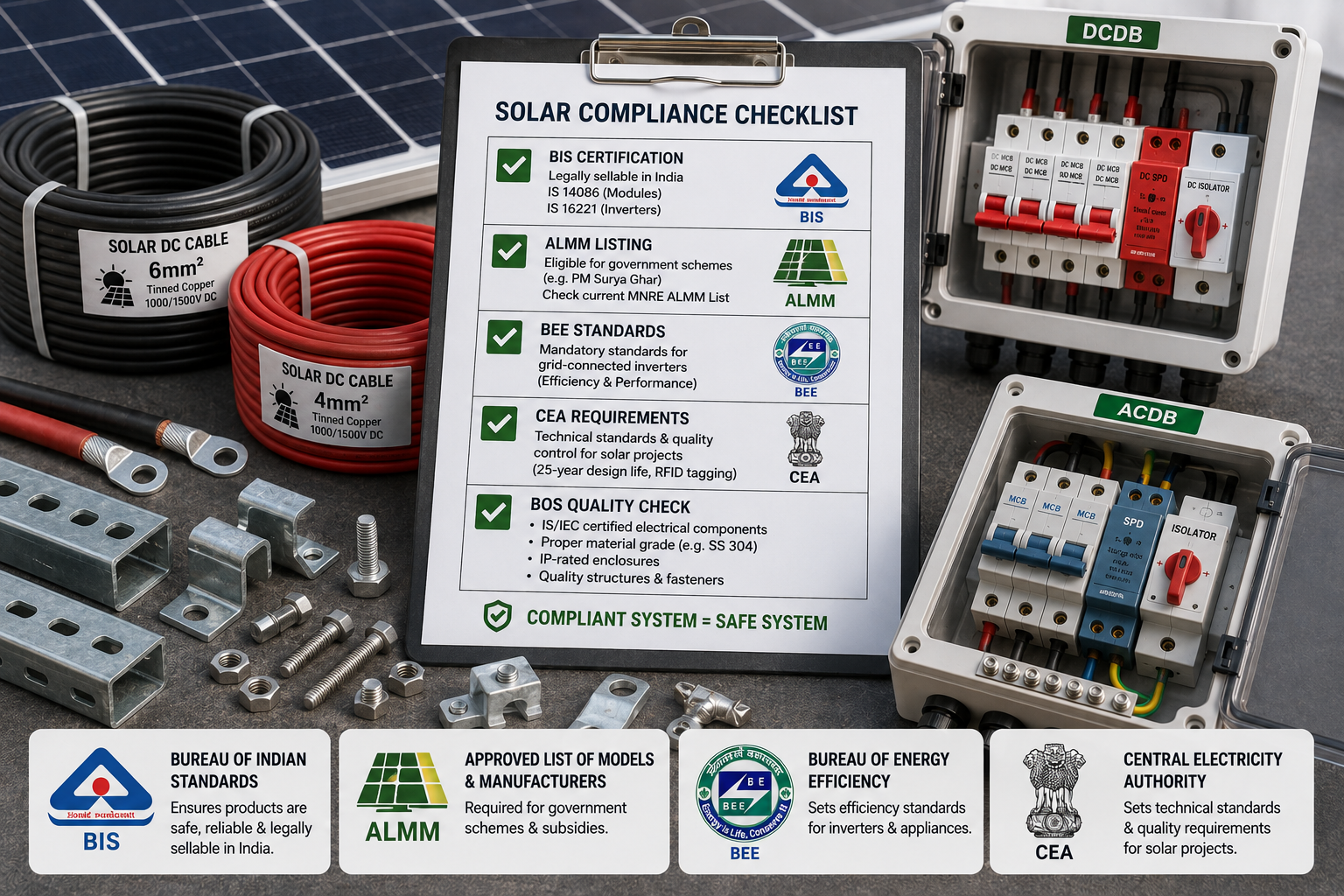
- IS 14086 covers crystalline silicon PV modules — Part 1 performance (aligned to IEC 61215), Part 2 safety (aligned to IEC 61730). The BIS Quality Control Order of 2022 made this mandatory for all modules sold in India, including imports.
- IS 16221 covers grid-connected solar inverters, including anti-islanding requirements (aligned to IEC 62116).
No valid BIS licence, no legal sale. Simple as that.
ALMM — The Right to Subsidy
ALMM, the Approved List of Models and Manufacturers, is maintained by MNRE. This is the one that matters for PM Surya Ghar and government tenders.
The key point installers miss: BIS-certified is not the same as ALMM-listed. A product can be perfectly legal to sell commercially (BIS-certified) but still not qualify for PM Surya Ghar because it isn’t on the ALMM. Use a non-ALMM module on a subsidy job and you risk disqualifying the whole installation from the CFA.
BIS certification is a prerequisite for ALMM listing — but it’s only the first step.
BIS says you can sell it. ALMM says you can claim subsidy on it. Confuse the two and a project loses its grant.
The Other Bodies Worth Knowing
[Image: logos/flowchart of MNRE, BIS, BEE, CEA roles. Alt text: Solar regulatory bodies in India – MNRE BIS BEE CEA roles]
- BEE (Bureau of Energy Efficiency): has brought in mandatory standards for grid-connected inverters (with phased timelines for larger units), so even subsidy-driven rooftops use efficient, certified inverters.
- CEA (Central Electricity Authority): its 2026 technical-standards amendment set requirements like a minimum 25-year design life for onshore solar plants and quality-control measures such as RFID tagging on modules.
Where BOS Components Fit
Here’s the honest state of play: modules and inverters have hard, mandatory standards. BOS components — mounting, cables, distribution boxes — don’t yet sit under one uniform approved list. That doesn’t make quality optional; it makes your supplier’s standards the safeguard. Look for IS/IEC-certified electrical components, proper material grades (like SS 304 fasteners), and IP-rated enclosures, because nobody is going to enforce it for you on the BOS side — yet.
A Quick Compliance Checklist
- Confirm modules are ALMM-listed for any PM Surya Ghar / tender job
- Confirm modules and inverters carry valid BIS certification (IS 14086 / IS 16221)
- Check inverters meet BEE requirements
- For BOS, demand IS/IEC-certified electrical parts and proper material specs
- Always verify the current lists — ALMM and standards get updated
FAQ
Can I use a BIS-certified but non-ALMM module on PM Surya Ghar? No — ALMM listing is required for the subsidy. BIS alone isn’t enough.
Are BOS components covered by ALMM? Not under the same module/inverter framework as of 2026. Quality is governed by IS/IEC standards where they apply and, in practice, by your supplier.
How often do these lists change? Regularly. Always check the MNRE portal for the current ALMM and the latest requirements before specifying.
Conclusion + CTA
Get the acronyms straight and compliance stops being scary: BIS to sell, ALMM to subsidise, IS to verify. And on the BOS side, where the rules are still catching up, choose a supplier who treats quality as the standard.
Sourcing compliant, quality BOS material?
We supply certified electrical components and properly specced structures and fasteners, in bulk, pan-India.
[Get a bulk quote on WhatsApp →] (+91 93277 22400)

Written by
parikshit
Written by