
ACDB vs DCDB: What’s the Difference, and Where Does Each One Go?

Written by
parikshit
Panels and inverters get all the attention. But sit between them are two boxes that quietly decide whether a solar system runs safely for twenty years or trips, fails, and costs you a site visit every monsoon. The ACDB and the DCDB. Get these two right and most electrical problems never happen in the first place.
If you spec systems for a living, you already know the acronyms. What trips people up is the detail: which protections actually belong in each box, where to mount them, and how to size them for the system in front of you. This guide lays it out the way it matters on site.
Drop-cap opening paragraph:
The simplest way to remember the difference is to follow the current. Power leaves your solar panels as DC (direct current). It hits the inverter, becomes AC (alternating current), and then goes to the load or the grid. The DCDB sits on the DC side, before the inverter. The ACDB sits on the AC side, after it. Same job — protect and distribute — on two different kinds of electricity.
What a DCDB Actually Does
The DC Distribution Box (DCDB) sits between your solar array and the inverter. Its job is to collect the DC power coming off your panel strings, route it cleanly to the inverter, and — most importantly — protect everything upstream and downstream if a fault occurs on the DC side.
DC faults are nastier than AC faults. DC arcs don’t self-extinguish the way AC arcs do, so the protective devices inside a DCDB have to be DC-rated specifically. A box stuffed with AC-rated parts is a common (and dangerous) cost-cut.
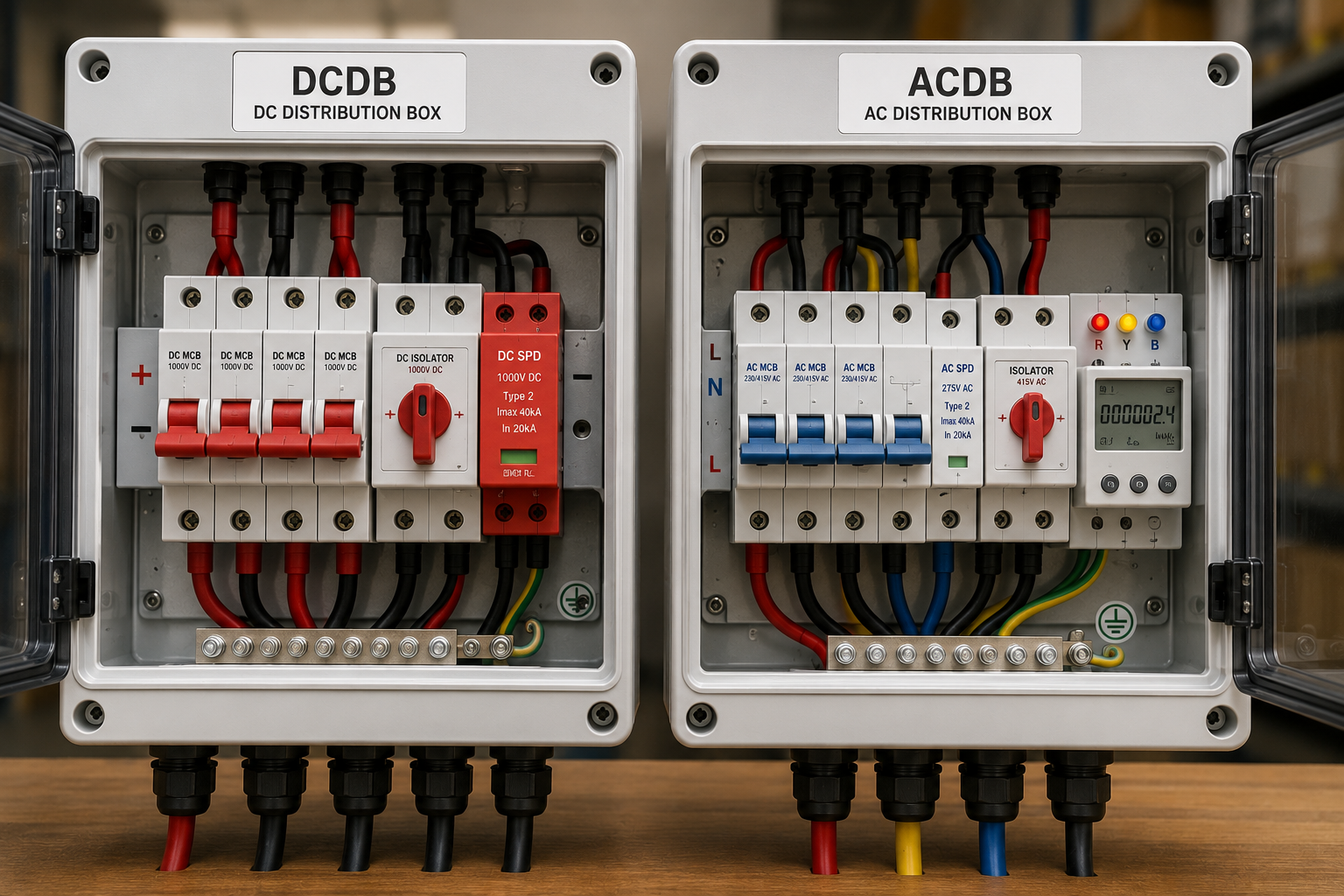
What’s typically inside a DCDB:
- DC MCBs or fuses — string-level overcurrent protection, so a fault in one string doesn’t take down the inverter or the rest of the array
- DC SPD (Surge Protection Device) — guards against lightning and switching surges, which is critical given how exposed most arrays are
- DC isolator / disconnect switch — lets a technician safely isolate the DC side for maintenance
- Busbars, cable glands, and an earthing bar — for clean terminations and grounding
For Indian rooftop and small ground-mount conditions, an IP65, UV-stable enclosure is a sensible baseline — it has to live outdoors in heat, dust, and rain.
What an ACDB Actually Does
The AC Distribution Box (ACDB) sits between the inverter and the load (or the grid connection point). Once the inverter has converted DC to AC, the ACDB distributes that power safely and provides protection on the AC side.
What’s typically inside an ACDB:
- AC MCB (for lower currents) or MCCB (for higher currents) — trips on overload or short circuit
- AC SPD — protects connected equipment from voltage surges by diverting them to earth
- Isolator — for safe disconnection and maintenance
- Optional energy meter / indicators — some ACDBs include metering or RYB phase indicators
The ACDB is also where single-phase vs three-phase matters most in practice.
Single-Phase or Three-Phase?
This is usually decided by system size. As a rough rule used widely in the field:
| Factor | DCDB | ACDB |
| Side of inverter | DC side (before) | AC side (after) |
| Handles | DC from panels | AC to load/grid |
| Key protections | DC fuse/MCB, DC SPD, DC isolator | AC MCB/MCCB, AC SPD, isolator |
| Mount location | Near the array / string combiner, close to inverter | Near inverter output / main AC point |
| Single vs three phase | Matches system | 1–6 kW often single-phase; larger systems three-phase |
| Enclosure | IP65, UV-stable | IP65, UV-stable |
A single-phase setup has a live and a neutral; a three-phase setup carries three live conductors and a neutral to handle higher loads. Match the box to the inverter and the connection — don’t mix them.
Skip these boxes to save money and you usually pay for it twice — once in failed equipment, and again in the site visit to fix it. ACDB and DCDB are among the cheapest components in the whole system, and they protect the most expensive ones.
Where to Mount Them (and Why It Matters)
[Image: a clean install showing DCDB near the inverter and ACDB at the AC point. Alt text: DCDB and ACDB mounted near solar inverter – correct placement]
Placement isn’t just tidiness — it affects losses, safety, and how quickly someone can service the system later.
- DCDB: mount close to the inverter or at the string combiner location. Keep DC runs short and accessible. Long DC runs mean more voltage drop and more exposure.
- ACDB: mount near the inverter output or the main AC point, with clear working space around it for safe maintenance.
Short, accessible, well-labelled runs make fault-finding fast — which is the whole point of having distribution boxes in the first place.
How to Spec the Right ACDB and DCDB
A few checks that separate a reliable box from a problem waiting to happen:
- Match the rating to the system — the box must handle your system’s voltage and current with margin, not just barely
- DC-rated parts on the DC side — never substitute AC-rated components into a DCDB
- IS / IEC-certified components — for quality, safety, and compliance
- Right SPD type — Type 2 SPD suits most rooftop and small ground-mount sites; Type 1 where lightning exposure is high
- Quality branded internals — protection devices from trusted brands fail less and trip more predictably
- Custom configuration — for non-standard string counts or layouts, a made-to-spec box beats forcing a standard one to fit
Frequently Asked Questions
Is a DCDB really necessary? For most grid-connected and string-inverter systems, yes. It provides string-level protection and a safe DC disconnect that the inverter alone doesn’t fully cover.
Is an ACDB required? It’s strongly recommended and often required for safety and compliance, since it protects the AC side and provides isolation.
Can one box do both? They protect different kinds of current with differently-rated parts, so they’re separate boxes. Some packaged solutions combine them in one enclosure, but the AC and DC sections remain distinct internally.
What enclosure rating should I look for? IP65 with UV-stable, flame-retardant construction is a practical baseline for outdoor Indian conditions.
Conclusion + CTA
Treat the ACDB and DCDB as the backbone of the system, not an afterthought. Spec them correctly, use DC-rated and IS/IEC-certified parts, mount them where they can be serviced, and they’ll quietly protect your production for years.
Need ACDB/DCDB boxes for a project? We supply them in bulk with quality branded components like Havells — single-phase, 1 In 1 Out, and custom configurations on request. [Get a bulk quote on WhatsApp →] (+91 93277 22400)

Written by
parikshit
Written by
