
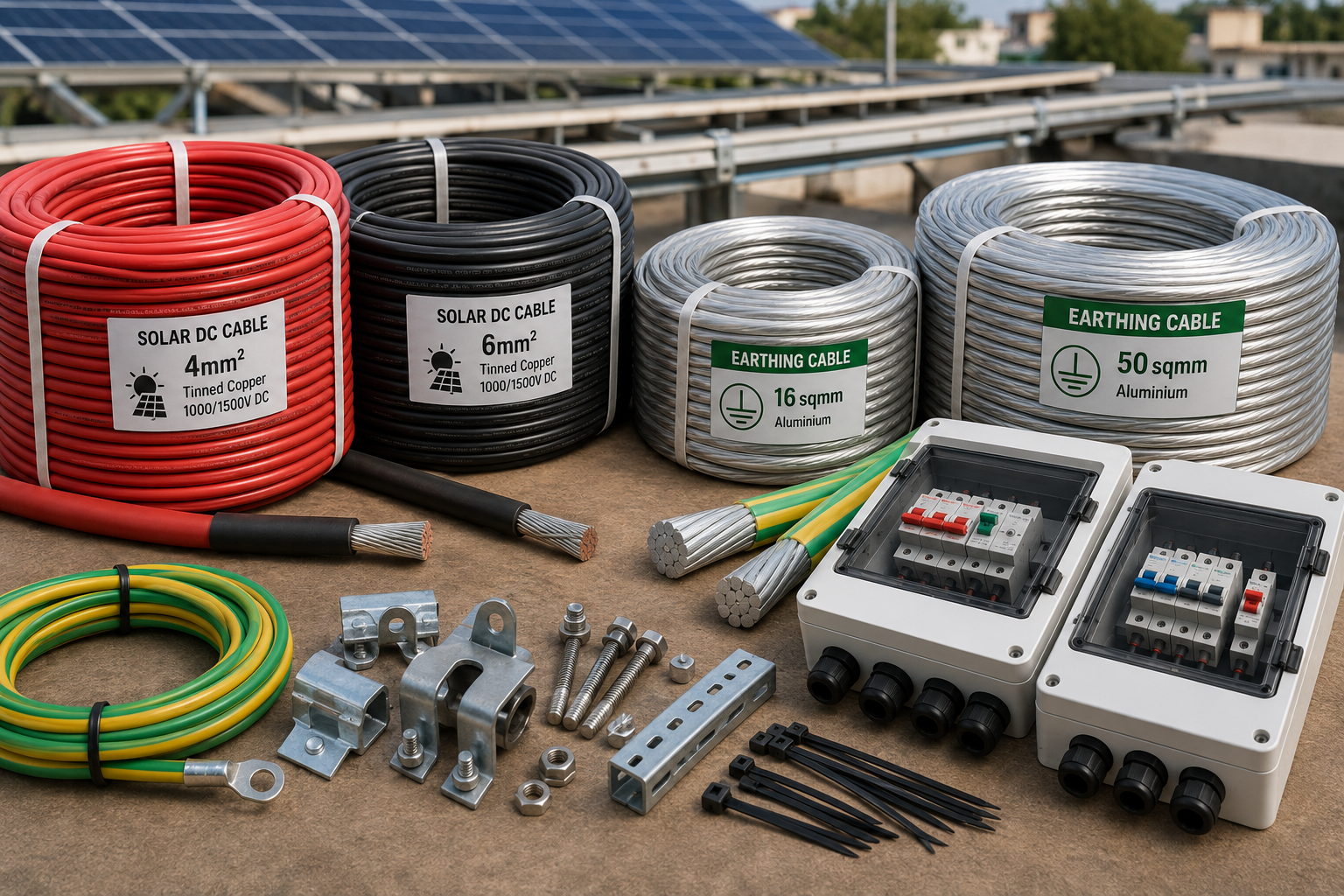
Solar Cable Sizing: How to Choose DC, AC, and Earthing Cable

Written by
parikshit
Cable is the part of a solar BOM that’s easiest to under-spec and hardest to fix once it’s installed. Undersize it and you lose generation to voltage drop, run hotter than you should, and risk a safety issue. Oversize everything and you’ve spent money you didn’t need to. The skill is matching the cable to the job — and a solar system actually has three different cable jobs.
This guide walks through all three: the DC cable from panels to inverter, the AC cable from inverter to load, and the earthing cable that grounds the whole system. We’ll cover the sizes that come up most on Indian projects — including why earthing cable jumps from 16 sqmm to 50 sqmm.
Drop-cap opening paragraph: Before sizing anything, separate the three runs in your head. DC cable carries the raw output of the array to the inverter and is the most performance-sensitive run. AC cable carries the inverter’s output onward and is sized to the system’s kW. Earthing cable carries fault current safely to ground and protects people and equipment. Each is sized on different logic, so treating “solar cable” as one thing is the first mistake.
DC Cable — Usually 4mm² or 6mm²
The DC cable connects your panel strings to the inverter. It’s almost always single-core tinned copper, rated for high DC voltage (typically 1000V–1500V) with XLPO/XLPE insulation that’s UV-resistant for outdoor life.
The two sizes you’ll reach for most:
- 4mm² — suits smaller systems and shorter runs, with currents under about 30A. Good for compact residential rooftops.
- 6mm² — better for larger systems, longer runs, or currents up to roughly 50A. Lower voltage drop over distance, and headroom for future expansion.
The deciding factors are current, run length, and acceptable voltage drop. Good practice keeps DC voltage drop in the 1%–3% range. Once a run gets long (over ~15–20 metres) or the system gets bigger, stepping up from 4mm² to 6mm² is usually cheaper than the generation you’d lose to voltage drop over 25 years. For long runs or big strings, 10mm² and 16mm² DC cable also exist.
Why Copper for DC?
You’ll see aluminium cable on the market because it’s cheaper and lighter. For DC string cable, though, copper is the standard choice: it’s significantly more conductive, so it loses less power to resistance over the run. Aluminium has its place — typically in larger, cost-sensitive runs and in earthing — but for the performance-critical DC side, copper earns its cost.
A cheaper cable that drops 2% more voltage isn’t a saving — it’s a 25-year discount on your own generation. Size the DC run for output, not just for the bill of materials.
AC Cable — Sized to the System
[Image: AC cable run from inverter to the AC distribution point. Alt text: Solar AC cable run from inverter to distribution point]
The AC cable carries the inverter’s output to the load or the grid connection. It’s sized to the system’s power rating and the same voltage-drop discipline applies. Single-phase systems and three-phase systems use different conductor arrangements, so match the AC cable to the inverter’s output configuration and the distance to the connection point.
Earthing Cable — Where 16 sqmm vs 50 sqmm Comes In
This is the part contractors ask about most, because the jump in size looks dramatic. Earthing (grounding) cable doesn’t carry working current — it carries fault current safely to ground, and it’s central to both safety and lightning protection. It’s commonly aluminium, since the run is about a safe low-resistance path rather than minimising working loss.
As a practical field guide:
| Cable job | Typical size | Material | Sized on |
| DC string cable | 4mm² / 6mm² (up to 16mm²) | Tinned copper | Current, run length, voltage drop |
| AC cable | Per system kW | Copper / aluminium | System rating, distance |
| Equipment / smaller earthing | 16 sqmm | Aluminium | Equipment & frame bonding |
| Main / system earthing & LA | 50 sqmm | Aluminium | System size, lightning protection |
- 16 sqmm earthing cable is commonly used for equipment and structure earthing — bonding module frames, mounting structures, and smaller installations.
- 50 sqmm earthing cable steps up for main system earthing and lightning-arrestor (LA) runs, and for larger systems where a heavier conductor is needed to carry potential fault and surge currents safely.
The right size depends on the system, the fault current it could see, and local code — so always cross-check against the project’s earthing design rather than defaulting to one size everywhere.
A Quick Sizing Checklist
- Calculate the current the run will actually carry, with margin
- Measure the run length — voltage drop grows with distance
- Keep DC voltage drop in the 1%–3% band
- Use copper for DC string cable; aluminium is fine for earthing
- Match earthing size to the earthing design (16 sqmm for equipment, 50 sqmm for main/LA, per the project)
- Follow local electrical codes — they govern cable type and size
- Plan for expansion — a slightly larger cable now can save a rewire later
Frequently Asked Questions
4mm or 6mm DC cable — how do I decide? Short runs and smaller systems (under ~30A) are usually fine on 4mm². Longer runs, bigger systems, or currents up to ~50A do better on 6mm² because of lower voltage drop.
Why is earthing cable aluminium and DC cable copper? DC cable is sized to minimise working-current losses, where copper’s conductivity pays off. Earthing cable carries fault current to ground, where a heavier, cost-effective aluminium conductor does the job well.
When do I use 50 sqmm instead of 16 sqmm earthing cable? Broadly, 16 sqmm for equipment/structure earthing and smaller systems; 50 sqmm for main system earthing and lightning-arrestor runs or larger systems. Always confirm against the project’s earthing design and local code.
Conclusion + CTA
Cable sizing rewards a little discipline up front. Separate the DC, AC, and earthing runs, size each on its own logic, respect voltage drop and local code, and you’ll get a system that’s safe, efficient, and cheap to maintain.
Need solar or earthing cable for a project? We supply solar DC cable and aluminium earthing cable (16 / 50 sqmm) in bulk, with fast pan-India dispatch. [Get a bulk quote on WhatsApp →] (+91 93277 22400)

Written by
parikshit
Written by